Our research team manually verifies these brokerage rates, rules, and details directly against official SEBI disclosures and the broker's active tariff sheets.
Zerodha Review 2026
India's largest and most trusted discount stock broker.
Exclusive Promo
Offer: 10% brokerage sharing + 300 reward points
Open Free Account*T&C: Open an account using your link
Analyst Recommendation
Zerodha stands as India's premier discount stock broker, scoring an outstanding 9.8 out of 10. Renowned as the industry disruptor that first introduced zero-brokerage investing to Indian retail participants, it remains the gold standard for platform speed, operational transparency, and educational resources in 2026. With the recent introduction of its Margin Trading Facility (MTF) and the removal of online account opening fees, Zerodha has successfully resolved its most persistent customer complaints. The platform operates on a bootstrapped, debt-free business model, which guarantees high security for client assets and shields the platform from commercial pressures, making it an exceptional partner for investors and active traders alike.
Scorecard Metrics
Key Takeaways & Highlights
- ✓Pioneer of discount brokerage in India, serving over 12 million active clients.
- ✓Completely free online trading and Demat account opening for all retail individuals.
- ✓Flat ₹20 or 0.03% pricing model across Intraday, Futures, Options, and Commodities.
- ✓Kite trading platform is widely recognized for its stability, speed, and clutter-free interface.
- ✓Recently launched Margin Trading Facility (MTF), offering up to 5x leverage at a competitive 14.6% p.a.
- ✓Varsity platform offers the most comprehensive, free financial education ecosystem in India.
Corporate Profile & Regulatory History
| Established Year | 2010 |
|---|---|
| Founding Executives | Nithin Kamath, Nikhil Kamath |
| Corporate HQ | Bengaluru, Karnataka |
| Active Clients (NSE) | 12.5 Million+ |
| SEBI Complaint Ratio | 0.02% (Among the lowest in the retail broking sector) |
Founded in 2010 by brothers Nithin and Nikhil Kamath, Zerodha (a combination of 'Zero' and 'Rodha', the Sanskrit word for barrier) was established with a singular mission: to eliminate the high brokerage barriers faced by retail investors in India. Before Zerodha's entry, traditional brokers charged percentage-based brokerages (often ranging from 0.1% to 0.5% or more of transaction value), making trading highly expensive for retail participants. Zerodha introduced the concept of discount broking, charging a flat fee of ₹20 per executed order regardless of transaction size, which drastically disrupted the industry.
Unlike its heavily funded VC-backed competitors, Zerodha is entirely bootstrapped and has been consistently profitable since inception. This independent financial structure has allowed the founders to prioritize long-term platform stability and retail client interests over short-term monetization pressures. Today, Zerodha is India's largest discount stock broker by trading volume, serving over 12 million clients and processing up to 10 million trades daily. By keeping its focus on technology and low transaction costs, it has maintained a dominant market position.
Over the years, Zerodha has expanded its product ecosystem beyond stock trading. It launched Coin, a direct mutual fund platform that removes distributor commissions; Console, a comprehensive reporting backoffice; and Varsity, an educational hub. In 2026, Zerodha continues to lead the tech-broker space by retaining its high operational integrity, displaying an exceptionally low complaint ratio at the National Stock Exchange (NSE), and introducing competitive margin lending facilities to better compete with full-service firms.
A primary key to Zerodha's popularity is its corporate governance. By remaining debt-free and refusing to engage in aggressive client acquisition schemes or margin funding models that expose the firm to systemic risks, the broker has established a reputation for safety. This reputation is critical for high-net-worth individuals (HNIs) who maintain substantial long-term demat holdings and prioritize custody security over all other parameters. The low complaint ratio of 0.02% at the NSE further demonstrates their commitment to client satisfaction.
Tariff Sheet & Transaction Fee Breakdown
Here is the verified fee schedule for Zerodha across all trading segments:
| Fee Parameter | Pricing Rate / Charges |
|---|---|
| Account Opening (Online) | ₹0 (Free online account opening for trading & demat) |
| Account Opening (Offline) | ₹400 (Paper-based physical application processing fee) |
| Demat Account AMC | ₹300 + GST per year (billed quarterly at ₹75 + GST; waived for the first year for individual accounts opened after June 1, 2026) |
| Equity Delivery Brokerage | ₹0 (Completely free for lifetime, zero brokerage) |
| Equity Intraday Brokerage | Flat ₹20 or 0.03% per executed order (whichever is lower) |
| Equity Futures Brokerage | Flat ₹20 or 0.03% per executed order (whichever is lower) |
| Equity Options Brokerage | Flat ₹20 per executed order |
| Commodity Trading | Flat ₹20 or 0.03% per executed order (whichever is lower) |
| Currency Trading | Flat ₹20 or 0.03% per executed order (whichever is lower) |
| DP Charges (per debit debit) | ₹13.00 + GST per scrip per day on debit (sell transactions) from Demat |
| Call & Trade Brokerage | ₹50 + GST per executed order placed via telephone desk |
| Funds Transfer Fee | ₹9 per transaction via Net Banking; ₹0 via UPI transfers |
Zerodha's pricing structure is famously transparent, with no hidden layout charges. Equity delivery remains absolutely free, which is ideal for long-term investors. By introducing zero brokerage on delivery, Zerodha forced the entire Indian brokerage industry to transition towards discount models. However, it is essential for traders to look closely at secondary charges such as DP (Depository Participant) fees. At Zerodha, DP fees stand at ₹13.00 plus GST per scrip per day on the sell side, which is in line with or slightly lower than other major discount brokers like Upstox (₹18.50) and Angel One (₹20.00).
For Intraday and F&O trading, the flat ₹20 fee caps transaction expenses, which saves heavy volume traders thousands of rupees compared to percentage-based brokers. If a trade value is very small, the fee scales down to 0.03%, ensuring that small retail participants are not unfairly penalized. Furthermore, the ₹300 annual AMC is charged quarterly (₹75 + GST), making it less noticeable, and the newly implemented waiver for the first year makes onboarding zero-cost for newcomers.
It is worth noting that while brokerage is low, statutory government taxes (STT, Stamp Duty, GST, and SEBI fees) are mandatory for all brokers. Securities Transaction Tax (STT) on equity delivery is 0.1% on buy and sell sides, while for intraday it is 0.025% on the sell side. Active traders should utilize the brokerage calculator to assess these statutory charges before planning trades, as they often exceed the flat ₹20 brokerage fee. For instance, a delivery buy and sell of ₹10,00,000 worth of shares will result in ₹2,000 in STT alone, showing that government duties, not brokerage, dominate transaction friction.
The Depository Participant (DP) fee at Zerodha is managed through CDSL (Central Depository Services Limited). Whenever you sell delivery shares, a fee of ₹13 plus GST is debited per company (ISIN) per day. For example, if you sell shares of Reliance and TCS on the same day, you will be charged ₹26 + GST, regardless of the quantity sold. Understanding this mechanism is vital for swing traders who sell small parcels of shares frequently, as it can accumulate into a significant cost if not budgeted for.
💡 Important Operational & Square-off Fees
- Auto-Squareoff Charge: ₹50 + GST per order if intraday positions are not closed by 3:20 PM by the trader.
- Physical Statement Charges: ₹20 per page courier charges + GST for physical contract notes.
- Demat Pledge/Unpledge Charges: ₹30 + GST per transaction for margin funding setups.
- Off-Market Transfer Charges: ₹25 or 0.03% of transfer value (whichever is higher) plus GST.
Account Opening & Verification Guidelines
Opening a demat and trading account with Zerodha is fully paperless. Here is the documentation required and steps to register:
Required Documents Checklist:
- Permanent Account Number (PAN) Card copy.
- Aadhaar Card linked to an active mobile number for receiving OTPs.
- Canceled Cheque or Bank Statement showing MICR, IFSC, and account number clearly.
- Income Proof (Required only for trading F&O, commodities, or currencies): Latest 6 months bank statement, 3 months salary slip, Form 16, or ITR acknowledgment.
- Scanned copy of signature on plain white paper.
- Live photo via webcam or mobile camera for IPV (In-Person Verification).
Trading Platforms & Infrastructure
Zerodha provides a modern suite of trading software for browsers, mobile devices, and automated developers. Here is our hands-on review:
🖥️ Kite Web (Browser Platform)
Kite Web is arguably the most stable browser-based trading platform in the Indian stock market. It operates with a minimalist design paradigm, loading in milliseconds and running smoothly even during high-volatility trading sessions. The platform avoids flash banner ads, stock recommendation pop-ups, or distracting tickers, allowing traders to focus entirely on charts and market depth.
The charts on Kite Web are exceptionally robust, allowing traders to toggle between TradingView and ChartIQ. Traders can place orders directly from the chart screen and set up automated multi-chart grids. The platform also offers extensive keyboard shortcut configurations and real-time market depth data (up to 20 depths with a subscription), making it a favorite for intraday momentum traders.
The GTT (Good Till Triggered) order type is a signature feature of Kite. Unlike standard limit orders which expire at the end of the trading day, GTT orders remain active for up to 365 days on Zerodha's servers. When the target price is hit, the order is sent to the exchange. This is incredibly useful for long-term investors and swing traders who cannot monitor the market continuously. It allows setting up long-term buy targets and stop-losses without locking up funds in advance.
Key Web Features:
- Minimalist, clutter-free user interface designed for speed and low bandwidth usage.
- Deep integration with both TradingView and ChartIQ charting libraries with over 100 technical indicators.
- Advanced order types including GTT (Good Till Triggered) with 1-year validity for target/stoploss placement.
- Basket order features for margin benefit hedging and multi-leg strategies.
- Iceberg orders which automatically split large order quantities to minimize market impact.
📱 Kite Mobile (Android & iOS)
Kite Mobile is a highly optimized extension of the desktop platform. Available for iOS and Android devices, the application runs on a clean API structure, ensuring that it consumes minimal battery and works reliably even under weak mobile signals. Order entry takes only two clicks, and swipe-to-trade mechanisms make execution swift.
Unlike competitors whose mobile apps feel cluttered with marketing promotions for mutual funds, insurance, and personal loans, Kite Mobile stays dedicated exclusively to tracking and trading. While it lacks some of the advanced scripting tools of traditional desktop terminals, its charting functionality on mobile is top-notch, supporting drawing tools, indicators, and historical candle data.
To ensure stability during peak hours (such as Union Budget days or election results), Zerodha has built a distributed server infrastructure. This partitioning of client accounts ensures that even if one server segment experiences high traffic, other users can trade without interruption. The app also features native TOTP (Time-based One Time Password) integration, removing the dependency on external SMS gateways for two-factor authentication, which boosts security against sim-swapping frauds.
Key Mobile Features:
- Biometric login (Fingerprint/FaceID) for rapid access.
- Customizable multi-watchlists with real-time price updates and visual indicators.
- Native push notifications for price alerts and order execution status.
- Dark mode layout for comfortable viewing during night trading or tracking.
- One-tap access to Console backoffice reports and portfolio holdings.
💻 Desktop Terminal & Console Reporting
Zerodha does not provide an installable, heavy-duty executable desktop terminal (like NEST or traditional EXE software) anymore. They retired their desktop application to focus on Kite Web, which they optimized to handle identical data throughput. Pro traders seeking a desktop experience simply use Kite Web inside a dedicated browser window.
For backoffice analytics, Zerodha provides Console. Console acts as the repository of your investment journey, providing tax-compliant reports, holding statements, and capital gains statements. Its visualization engine charts your net-worth curves and reveals hidden trading costs, helping active traders review performance objectively. The tax-harvesting tool inside Console is particularly useful, helping investors sell loss-making shares before the end of the financial year to offset short-term capital gains tax.
Key Terminal Features:
- Console provides comprehensive analytics for tax-ready P&L reporting.
- Detailed trade book logs showing exact brokerage, STT, and DP transaction fees.
- Corporate action tracking (dividends, splits, buybacks) automatically updated.
- Consolidated portfolio charts and sector-wise diversification insights.
App Interface & Charts Gallery
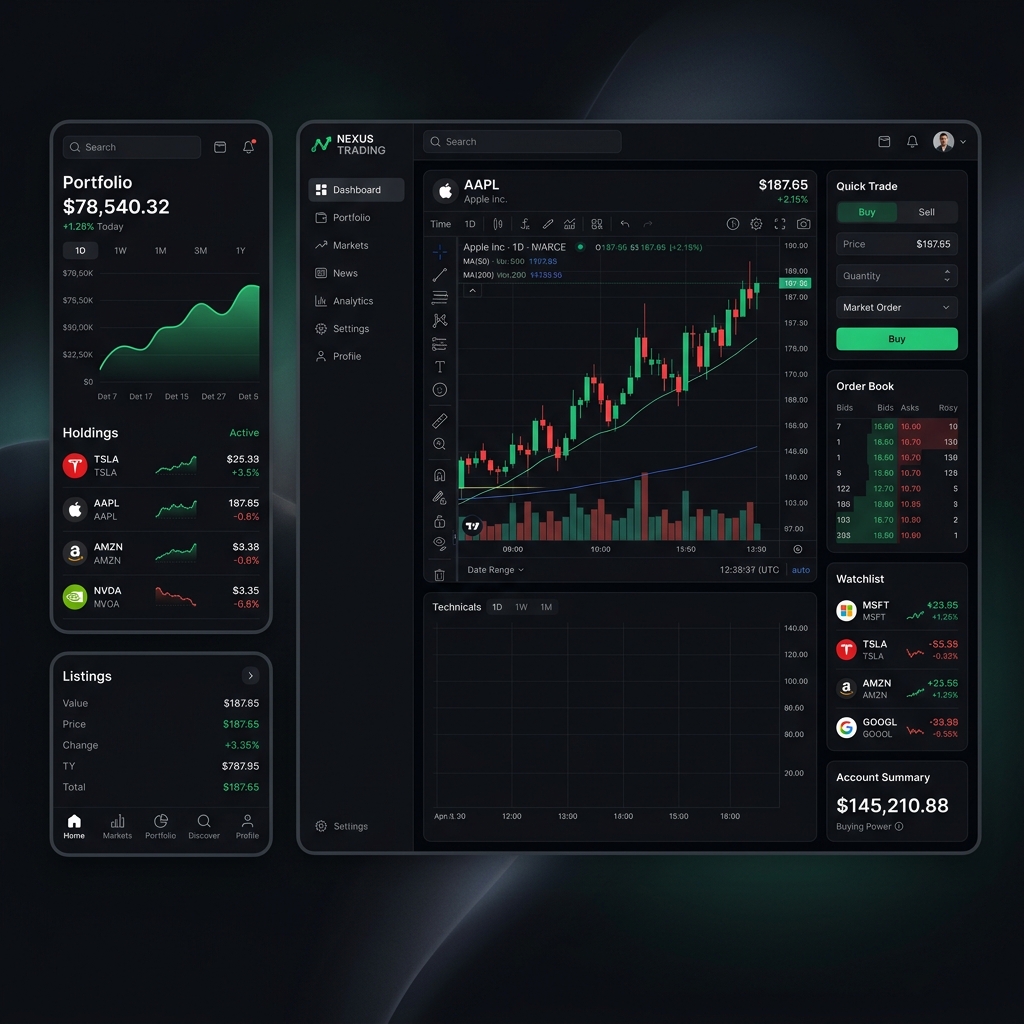
A live workspace capture showing chart grids, indicators, order templates, and portfolio trackers available inside the Zerodha ecosystem:
Developer & Algorithmic API Offerings
Zerodha caters to algo traders and programmers through its proprietary 'Kite Connect' developer APIs. Built on JSON/HTTP protocols, the API allows automated software to place orders, fetch real-time market ticks, and check margins. This makes it highly popular among quantitative retail traders.
The primary drawback is the cost: at ₹2,000 per month for order execution, it is relatively expensive compared to newer brokers like Dhan, Shoonya, or Fyers, which offer automated API access completely free. Zerodha justifies this fee by citing the reliability and support of their API infrastructure, but it remains a point of friction for small-capital retail developers. For professional traders running complex algo systems, however, the API's low-latency performance and high uptime make the expense worthwhile.
API Capabilities:
- Kite Connect API supports REST-like requests for orders, positions, and user profile queries.
- Websocket streaming for real-time tick-by-tick market data (LTP, bids, offers).
- Supports client SDKs in Python, Node.js, Java, PHP, Rust, and Go.
- Strict rate limits (3 requests per second for orders) to prevent server overload.
Research Capabilities & Educational Ecosystem
Zerodha maintains a strict corporate philosophy of being an execution-only stock broker. They do not offer stock tips, intraday recommendations, or long-term wealth advisories. While traditional full-service brokers encourage frequent trading by sending 'hot tips' via SMS or email, Zerodha believes that self-directed investing is the only way retail traders can survive in the long run. By not offering advisory services, they eliminate conflicts of interest.
To enable self-directed investing, they developed Varsity. Varsity is undoubtedly India's best financial education resource, containing highly detailed, structured text and video lessons written in plain English, Hindi, and Gujarati. Covering everything from basics of stock investing to advanced quantitative trading models, it is completely free and contains no hidden advertisements, making it an invaluable asset to the community.
For users seeking advanced analytics, Zerodha integrates with third-party partners through single sign-on (SSO). Sensibull provides option strategy building and trading; smallcase enables thematic basket investing; and Tickertape offers fundamental research and screeners. While these services have premium tiers, their integration within Kite is seamless, allowing users to build strategies externally and execute them instantly through their Zerodha account.
📊 Research Offerings:
- No direct stock tips, recommendations, or buy/sell calls.
- No dedicated research desk or equity advisory newsletters.
- Access to external research tools (like Tickertape and Sensibull) via single sign-on integration.
🎓 Educational Programs:
- Zerodha Varsity: A massive library of structured, free modules on stock market basics, technical analysis, fundamental analysis, and options.
- Varsity Mobile App: Gamified quizzes, flashcards, and reading modules with certifications.
- Interactive webinars, video series, and active investor forums.
Margin Trading Facility (MTF) & Security Pledging
For swing traders and long-term equity holders, utilizing margin collateral and leverage can significantly enhance trading efficiency. Here is how Zerodha supports margin products:
🛡️ Security Pledging (Collateral Margin)
✓ EnabledAllows you to pledge your long-term stocks or mutual funds in exchange for trading margins, subject to exchange-mandated hair-cut rates. Ideal for options writers who want to generate additional yields on passive holdings.
📈 Margin Trading Facility (MTF) Funding
✓ AvailableEnables you to purchase delivery stocks by paying only a fraction of the cost, with the broker funding the remaining balance. Positions can be held for up to 365 days, provided margins are maintained.
Historically, Zerodha resisted offering Margin Trading Facility (MTF) to retail clients, encouraging them to trade only with money they owned to avoid high-interest debts. However, in 2026, listening to the needs of swing traders who were moving to competitor platforms, Zerodha launched a highly transparent MTF program.
Under Zerodha's MTF, traders can get up to 5x leverage on 1,500+ approved stocks. The interest rate is structured at a flat 0.04% per day (14.6% per annum). The calculation is straightforward: if you take a funded margin of ₹1,0,000 for 10 days, the interest charge is ₹400. In comparison, some bank-backed brokers charge up to 18-24% per annum, making Zerodha's rates highly competitive. The interest is debited directly from the trading account ledger weekly.
Additionally, Zerodha offers collateral pledging. Investors can pledge their long-term equity delivery holdings or mutual funds to get collateral margin (after a standard percentage haircut). This collateral margin can be used directly to write options or trade intraday futures, allowing long-term investors to extract additional utility from their existing portfolio without liquidating assets. The pledge setup is fully digital and takes around 15 minutes, with a flat fee of ₹30 + GST debited per pledge transaction.
Customer Support Desk & Channels
Zerodha's customer support is structured around self-resolution and ticket tracking. Their online support portal contains thousands of detailed, step-by-step guides covering account opening, corporate actions, tax filings, and platform troubleshooting. If a user needs direct assistance, they can open a web ticket, which typically receives a resolution within 2 to 4 hours.
For urgent trading support, they maintain direct telephone helplines. Unlike traditional full-service brokers, Zerodha does not offer dedicated relationship managers (RMs) or aggressive helpdesks that dial clients to pitch trades. While this saves users from spam calls, it also means that telephone wait times can occasionally spike during high-volatility market crashes when thousands of traders try to call simultaneously. Notably, Zerodha does not offer instant 24/7 live-chat support on their website.
The ticketing system operates on a clear SLA (Service Level Agreement). Every query is assigned a ticket number, allowing traders to track the conversation history. This structural approach prevents resolution delays and ensures that operational queries are handled by technical specialists rather than sales representatives. The co-client support portal is continually updated with guides detailing circulars from SEBI and depository bodies, keeping traders informed.
✅ Zerodha Strengths (Pros)
- ✓Zero brokerage on equity delivery and direct mutual fund investments.
- ✓Completely free online account opening in 2026 with no upfront registration fees.
- ✓Renowned for Kite's clean, high-speed, stable trading interface.
- ✓Extremely high operational safety with a low complaint-to-client ratio.
- ✓Comprehensive educational resources via Varsity, helping self-directed traders.
- ✓Recently introduced Margin Trading Facility (MTF) with competitive interest rates (14.6% p.a.).
- ✓No commercial pressure, push notifications, or stock tip spam.
❌ Zerodha Limitations (Cons)
- ✗Does not offer any research tips, stock recommendations, or equity advisory.
- ✗Kite Connect developer APIs are expensive (₹2,000 - ₹4,000/month) compared to free competitor APIs.
- ✗Telephone support can experience hold delays during major market crashes.
- ✗No offline branch network or dedicated relationship managers for retail clients.
- ✗Auto-squareoff charges are high (₹50 per order) if intraday positions are left open.
- ✗No live chat support available on the web portal or trading app.
🎯 Who Should Choose Zerodha?
- Long-term investors who buy and hold equities, since delivery brokerage is ₹0.
- Technical analysts and swing traders who rely on high-fidelity TradingView charts.
- Systematic Mutual Fund investors looking for commission-free direct mutual funds via Coin.
- Cost-conscious traders who want a transparent broker with a spotless regulatory track record.
- Traders seeking margin lending (MTF) capabilities backed by a secure custody infrastructure.
⚠️ Who Should Avoid Zerodha?
- Traders who require human hand-holding, stock tips, or relationship managers to pick trades.
- Retail API developers on a small capital base who cannot justify the ₹2,00/month API fee.
- Absolute beginners who do not want to invest time in learning trading concepts (as there is no advisory support).
- High-frequency derivatives traders who execute hundreds of orders daily and want zero-brokerage models.
Comparison With Major Competitors
See how Zerodha stacks up against other top-rated discount brokers in India on core features, pricing, and ratings:
| Feature / Param |  Zerodha (Active) Zerodha (Active) |  Groww Groww |  Dhan Dhan |
|---|---|---|---|
| Overall Score | ⭐ 9.8 / 10 | ⭐ 9.5 / 10 | ⭐ 9.6 / 10 |
| Account Setup | Free | Free | Free |
| Annual AMC | Rs 300 / year | Free (Rs 0) | Free |
| Delivery Brokerage | Rs 0 | Rs 20 or 0.05% | Rs 0 |
| Intraday Brokerage | Rs 20 or 0.03% | Rs 20 or 0.05% | Rs 20 or 0.03% |
| Options (F&O) | Rs 20 per order | Rs 20 per order | Rs 20 per order / Rs 10 for women |
| Margin Funding (MTF) | ✓ Available | ✗ Not Offered | ✓ Available |
| Developer APIs | ✓ Provided | ✗ Unavailable | ✓ Provided |
The Final Verdict
Zerodha remains the undisputed benchmark of retail stock brokerage in India. By focusing on technology, pricing simplicity, and client education, it has earned the trust of over 12 million investors. It is not the cheapest option for active intraday F&O traders anymore—brokers like Shoonya and m.Stock offer completely free intraday trading—but Zerodha's platform reliability, lack of promotional spam, and clean business model more than justify the flat ₹20 fee.
The addition of the Margin Trading Facility (MTF) in 2026 removes one of the major reasons swing traders had for migrating to other platforms. When you choose Zerodha, you are choosing operational safety, software stability, and corporate integrity. For 95% of retail stock market participants, Zerodha is an exceptional choice to open a Demat and trading account.
In conclusion, Zerodha's execution-focused philosophy, coupled with their extensive educational support via Varsity, positions them as a utility-like service for the modern investor. Rather than treating users as commercial products to be cross-sold loans or insurance, Zerodha treats them as self-directed traders. This focus on corporate purity is unique in the modern fintech landscape and guarantees that your demat assets are in the safest possible hands.
Frequently Asked Questions (FAQ)
Q: Is Zerodha account opening really free in 2026?
Yes, Zerodha has made online account opening completely free for resident individuals. You do not pay any onboarding fees for trading and Demat accounts if you complete the process digitally using Aadhaar e-sign. Physical paper applications still cost ₹400.
Q: Are there any annual maintenance charges (AMC) at Zerodha?
Yes, the standard Demat AMC is ₹300 + GST per year. It is billed quarterly in instalments of ₹75 + GST. However, for individual accounts opened after June 1, 2026, the AMC for the first year is completely waived.
Q: Does Zerodha offer Margin Trading Facility (MTF)?
Yes. Zerodha launched MTF in 2026. You can get up to 5x leverage on over 1,500 approved stocks. The interest rate on the funded amount is 0.04% per day, which translates to approximately 14.6% per annum.
Q: Are equity delivery trades completely free?
Yes, brokerage on equity delivery trades is ₹0. However, statutory government taxes such as Securities Transaction Tax (STT) of 0.1% (on buy and sell value), GST, Exchange Transaction charges, SEBI fees, and DP charges (₹13 + GST per scrip per day on debit) are still applicable.
Q: How much does Zerodha charge for F&O trades?
Zerodha charges a flat ₹20 per executed order for Options trades. For Futures, it charges ₹20 or 0.03% per executed order (whichever is lower).
Q: Does Zerodha offer direct mutual funds?
Yes, you can buy direct mutual funds completely free of commission through Zerodha's dedicated platform called Coin. There are no brokerage charges or platform fees for mutual fund transactions.
Q: Can I do automated trading with Zerodha?
Yes, you can automate your trades using the Kite Connect APIs. Access to the execution APIs costs ₹2,000 per month, and historical market data APIs cost an additional ₹2,000 per month.
Q: What is the auto-squareoff charge at Zerodha?
If you open an MIS (Intraday) position and fail to close it before 3:20 PM, Zerodha's system will automatically square it off. An additional administrative charge of ₹50 + GST per order is applied for auto-squareoff.